



















Stanford recently released the 2026 AI Index, the field’s annual physical. One finding stopped me cold: the country that leads AI development is not the country that leads AI adoption. I’ll come back to that. First, what is this AI Index?
The AI Index is the most rigorous data-driven portrait of where AI stands: a yearly checkup across technical performance, investment, the labor market, the environment, public attitudes, regulation, the US-China race, and more. Four hundred pages, twelve headline takeaways, and a measurement apparatus no other institution has matched.
Most of the 2026 takeaways confirm what we already know or strongly suspect. AI performance is climbing, investment is exploding, the China gap has closed, young software engineers are losing their jobs. Familiar territory.
One number is surprising, though. The Index measures adoption (the share of a country’s population using generative AI tools) across two dozen economies in the second half of 2025. The leaders are not the countries you would guess.
The United Arab Emirates tops the list at 64%. Singapore is second at 61%. Norway, Ireland, and France round out the top five. Adoption correlates strongly with GDP per capita: richer countries have better infrastructure and more knowledge workers whose jobs benefit from these tools. That makes intuitive sense.
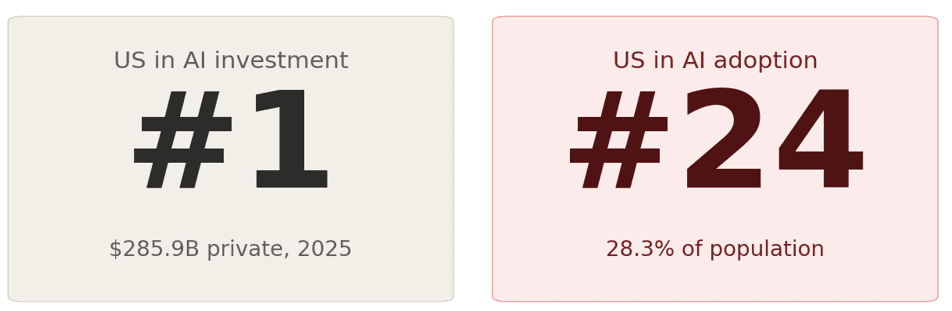
The United States ranks 24th, at 28.3%. That shocked me.
The country ranking figure, below, provides the broader list.

Here is what makes the gap strange.
In 2025, US private investment in AI reached $285.9 billion, 23 times China’s and more than the rest of the world combined. Many of the leading models are trained in American labs. Even with talent inflows down 89% since 2017, US researchers still outnumber any other country’s by a wide margin. By every supply-side measure, we are the country that builds AI.
By the Index’s adoption ranking, we sit 23 places behind the UAE, just ahead of the…