

















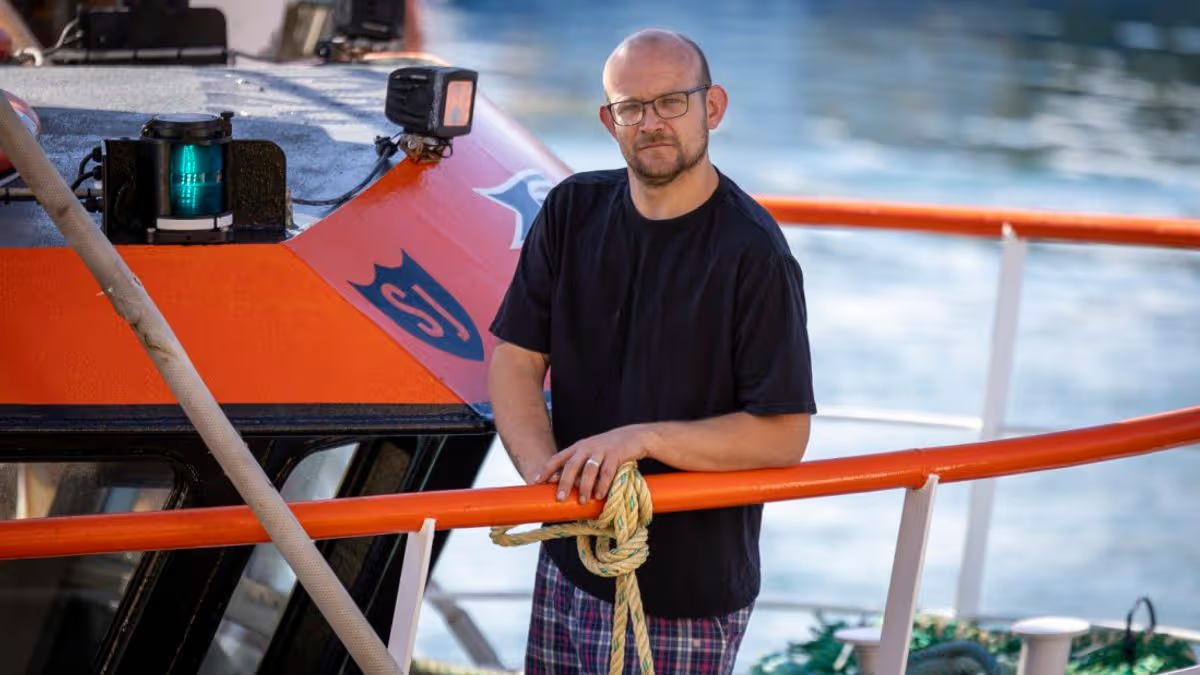

EXCLUSIVE: “We were promised the world and given nothing. Brexit is like a bad smell. Within six months of the vote, they had given out licences to all the big foreign boats again. It’s just money. It has always just been money”Brixham residents speak to The Mirror about how Brexit has impacted the town’s fishing industryGeorge Shipley doesn’t mince his words. The 34-year-old acting skipper stands on the quayside at Brixham harbour, the smell of salt and diesel thick in the early morning air, white plastic boxes stacked behind him and the Devon hills rising beyond the trawlers, and says what every fisherman here is thinking.”If a politician walked past me now on the quayside, he’d be getting a drink,” he says, nodding towards the cold, grey water below. He doesn’t mean a pint. Ten years on from the Brexit vote that was supposed to transform Britain’s fishing industry, this is where we have landed.Not in the sunlit sovereign waters the Leave campaign promised, but in a harbour of broken pledges, red tape, and barely suppressed fury. The timing could not be more bitter. Just one week after the tenth anniversary of that historic vote falls the date when, under the original terms of the Trade and Cooperation Agreement, British fishermen were finally supposed to get their waters back.Acting skipper George Shipley, 34, on the quayside at Brixham, where he says fishermen were “fed a load of lies” to get Brexit throughThe moment they had been waiting a decade for. The prize that was dangled before them in 2016, when slogans like “British waters for British fishermen” echoed from every Leave campaign platform in the land.Instead, last year Keir Starmer’s government quietly signed away those fishing rights for another twelve years – locking EU vessels into British waters until 2038. The arrangement was supposed to give Britain meaningful control. Instead, the status quo was extended in what industry leaders immediately called a betrayal. The promised dawn became another long night.”Really, what was Brexit for the UK fishing industry?” asks Barry Young, Managing Director of Brixham Trawler Agents, standing by the fish market his operation runs. “They used it as a bargaining chip. And the chip wasn’t big enough.”He adds: “I was ultimately a Leave. I believed what the UK government was telling us and the whole industry. We were made promises that didn’t come our way. You put your trust in the UK government, who run your country for you, and they’ve obviously let us down.”The headline numbers tell a complicated story. The UK fleet generated £1.15billion in fishing income in 2024, with operating profits rising 26 per cent from £267million to £337million. The fleet landed 716,000 tonnes of fish and shellfish, up 15 per cent on the previous year. On paper, an industry in rude health. But strip away the headline figures and a very different picture emerges. There are just 3,785 active vessels in the entire UK fleet, supporting 7,263 full-time jobs – a shadow of what the industry once was.In England, the fleet shrank by four per cent in 2024 alone, continuing what the industry’s own analysts describe as a post-Brexit rapid decline. Scotland’s fleet fell by a similar amount, down to 1,521 active vessels. Wales tells an even starker story – its fishermen spent 33 per cent more days at sea in 2024 yet still saw operating profits fall by almost ten per cent. In Northern Ireland, skippers are being forced to fish in less productive waters further from shore because the cost of Skilled Worker Visas for foreign crew has become prohibitive. Average incomes across all three Northern Irish fleet segments fell last year.Barry Young, Managing Director of Brixham Trawler Agents, voted Leave in 2016 but now says the fishing industry was “lied to”The profits being generated are flowing increasingly to the largest operators, while the small independent skipper – the backbone of ports like Brixham for generations – is being squeezed out of existence.Brixham itself is a town of extraordinary beauty and stubborn character. Pastel-coloured cottages tumble down the hillside to one of the most important fishing ports in England.On this clear morning, the harbour glitters, trawlers nudging gently against each other, orange floats and coiled ropes lining the dockside, some of the catch already landed before most of Britain has eaten breakfast.A statue of William of Orange stands at the harbour entrance, marking the spot where he landed in 1688 and started the Glorious Revolution. History runs deep here, but so does grievance.Martin Rogers has been at sea for 60 years. The 74-year-old scallop skipper is regarded on the harbour as one of the most respected men in the industry, a man whose word carries weight. He has a line that tells you everything about how fishermen view the political class.”Scallops are like politicians,” he says, with the slow certainty of a man who has earned the right to say whatever he likes. “They only come out during the day.” He smiles at his own joke – under the rules he is now governed by, he can only fish between 7am and 7pm.Rogers has fished these waters for six decades and watched government after government make the same journey to the quayside – promising support, demanding votes, then disappearing. “All they have ever done with the fishing industry is come down here to get votes and then shaft us at the end of the day,” he says. “Every year. All of them. We haven’t had one politician behind this industry.”The Brexit promises, however, were specific, and the betrayal was complete. Fishermen were told they would control their own quotas, expel foreign vessels, and be freed from European bureaucracy.Catches are landed at Brixham fish market, which has absorbed trade from ports devastated by the post-Brexit decline elsewhere in BritainA decade on, foreign boats still fish inside British limits while British vessels cannot reciprocate. Quotas have been hoovered up by large corporations, leaving small independent operators fighting for scraps. The paperwork has driven some from the industry entirely. “The minute I leave this harbour, they are tracking me,” Rogers says. “When I get around the breakwater, I have to start filling out computers. Five stages by the end of the day. Everything they do, they hit you.”Shaun Sturtridge, 34, bought his boat, the Endeavour, four years ago. He catches Dover Sole – up to two tonnes a month – and is precisely the kind of independent skipper the Brexit campaign claimed to champion. He is not feeling championed.”Brexit has done nothing for us,” he says flatly. “The big companies have taken the quotas. Where does that leave the little man? And you’ve got foreign crews too. If we are not allowed in their six-mile limit, they shouldn’t be allowed in ours.”Brexit’s commercial absurdities mount up. Sturtridge recently found it cheaper to sail to Holland to have work done on his boat than to use a local yard. “It was half the price in the EU,” he says, shaking his head. “It is a struggle to make a living. It is harder than it was ten years ago.”Shipley is more direct still. “We were just fed a load of lies to get it through, and look at us now,” he says. “We were promised the world and given nothing. Brexit is like a bad smell. Within six months of the vote, they had given out licences to all the big foreign boats again. It’s just money. It has always just been money.”He reserves particular contempt for Nigel Farage, the politician who perhaps more than any other made the fishing industry a symbol of the Leave cause. “I can’t stand the bloke,” Shipley says. “Politicians just talk out of the side of their mouths. Not one of them has got an honest bone in their body. They have nothing in common with us.”Brixham is, by the grim standards of post-Brexit fishing ports, one of the lucky ones.Ports around the country have seen boats disappear and businesses fold. The Devon town has absorbed many of those displaced vessels, its fish market filling the gap left by the collapse elsewhere.Scallop skipper Martin Rogers, 74, who has fished these waters for 60 years and says he would not vote for Brexit againYoung is clear-eyed about what that means. “The only reason we’re probably doing okay is because we’ve had to pick up the slack from the collapse of many, many ports,” he says. Fortune built on someone else’s misfortune.Even here, smaller one-man operators have quietly slipped away, defeated by paperwork and economics. Young voted Leave in 2016, convinced by the promises being made. He has since revised his view entirely. “Knowing what I know now, I was very, very blinkered,” he says. “The industry was definitely lied to back in 2016. I would not vote for Brexit.”Christine Plummer, 62, has run her shop, The Clothes Locker, on the harbour for eight years and watched the fishermen closely. “They’ve been lied to,” she says simply. “Fishing is a big part of this town, and they should be looked after. I would vote to go back into the EU to look after the fishermen.”At the Sprat and Mackerel pub, landlord Matt Heighway, 48, still believes Brexit could have worked if the politicians had done it properly. “We got a very watered-down version of what we were promised,” he says. “That’s led to a lot of the problems we’ve got now.” It is perhaps the most generous reading available. Most of this harbour is less forgiving.Shop owner Christine Plummer, 62, says Brixham’s fishermen “have been lied to” and would vote to rejoin the EU to protect themRogers has the last word, as befits a man with 60 years of sea behind him. “If the Brexit vote came about tomorrow,” he says, “I would not vote for it. Everything was there for us. Brexit has taken everything away.” There is no doubt that in Brixham some voted Leave and some voted Remain. Some still believe it could have worked, while others wish it had never happened.But ten years on from the referendum that was supposed to transform their lives, Britain’s fishermen have been betrayed twice over – first by the politicians who made the promises, then by the government that signed them away for another 12 years.The headline profits may look healthy. But behind them lies a fleet in long-term decline, an industry hollowed out from within, and a community of men who were promised the ocean and given a puddle, all while being charged for the privilege of standing in it.