


















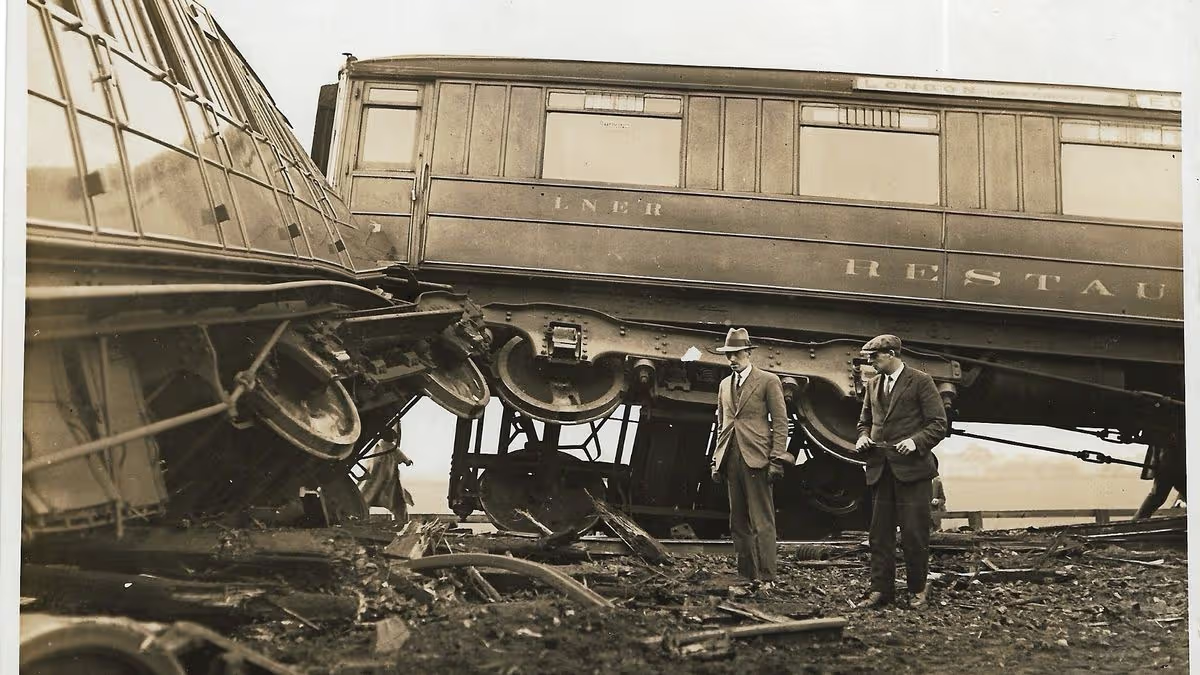

Seven days into the General Strike of May 1926, union man William Golighty stood at a packed meeting of Cramlington miners and said: “Stop everything on wheels.” Rumours were sweeping the tiny village that a coal train was headed their way. Golighty – grandfather of actor Robson Green – believed it should be stopped. It led to what Ed Waugh, who has written a play about it, calls “The most notorious incident of the whole General Strike.”The miners were living in brutal conditions, plunged into poverty and struggling to feed their families. The strike, called after mine owners demanded a 40% wage cut, had pushed them beyond the brink. William Muckle, one of eight miners who were jailed over what happened next, later told the BBC: “We were slaves. We were getting starvation wages.”However, rumours of the impending arrival of a coal train were false. Ed says: “It was nonsense, but these young miners took it literally. They went down and lifted a rail.”Eight miners were convicted. Robert Harbottle, 21, Thomas Roberts, 25, Arthur Wilson, 26, James Ellison, 29, William Stephenson, 22, William Baker, 28, William Muckle, 25, and Oliver Sanderson, 25(Image: Working Class Movement Library)Around 40 miners were involved, because the work demanded it. Ed continues: “Each of these rails was solid steel, 15 yards long, 45 feet, and it weighed 103 stone. Their intention was to slow the train down. Cramlington Station was about three quarters of a mile away from where they took the rail up. They waved a red flag, a red handkerchief, to try and stop it. But the train didn’t stop.”And it wasn’t carrying coal. It was The Flying Scotsman bound for London, with 281 passengers on board. Ed says: “The miners never, ever intended to do anything to any of the passengers. It was to stop a coal train. This could have been carnage.”Fortunately, only one person was injured, a man whose foot was struck by a falling case. Women from the village ran to the scene with towels and sheets to give first aid. One survivor told them: “Go home and wash your dirty selves and your dirty homes, we don’t want help from the likes of you.”Arthur Heayns was 10 and waiting for a bus home from school when news of the crash spread. He ran with two friends to the scene, about a mile and a half away. He stayed for hours, getting home at 8.30pm, where his 88-year-old grandfather took his thick leather belt to him for the one and only time.Coloured photograph of the eight imprisoned miners(Image: Fiona Mitford)Arthur recalled: “The tears were running down my cheeks and they were running down his as well. I’d never seen that before either.” Ed explains: “It was an act of desperation. They were angry, very, very angry. In the play, I asked ‘was Bill Golightly being provocative?’ William Muckle said ‘we didn’t need provoking. We had to do something.’”The Daily Graphic front page the following morning screamed “London express wrecked: dastardly outrage in North.” The story made international headlines and was raised in Parliament. The police sent in undercover agents and got nowhere.Ed says: “Everybody in the village of Cramlington knew what had happened. Everybody knew who had been involved. But nobody would talk.”Eventually, in June, six men turned King’s evidence. Ed adds: “In the BBC film you see how heartbroken the miners were, because these were their best friends.”The crash site, in Cramlington, Northumberland, 1926(Image: Ed Waugh)On June 30, 1926, a trial took place at Newcastle Moot Hall. Ed says: “Eight miners were convicted. Robert Harbottle, 21, Thomas Roberts, 25, and Arthur Wilson, 26, each received eight years. James Ellison, 29, and William Stephenson, 22, got six. William Baker, 28, William Muckle, 25, and Oliver Sanderson, 25, received four. Ellison died just six months after his release.”They were sent to Maidstone Prison in Kent, 330 miles from Cramlington, and were not treated as political prisoners. Ed says: “They were in with murderers and people who had committed incest. That sentencing was part of a carnival of reaction. The ruling class saying, ‘you will not do this again, this is what happens.’”They were allowed one visit a year from their families, hundreds of miles away. Absolutely vindictive. The campaign eventually got the government to relent: two visits a year, half an hour a time. One funny thing, they used to go to church on a Sunday because the vicar read out the football results. I’m sure they were Newcastle fans.”A campaign by the trade union rank and file and the Labour Party eventually forced the government’s hand. The women of the Cramlington Labour Party held rabbit pie and peas evenings to raise money. Even sections of the judiciary said the sentences were too harsh. The International Class War Prisoners Aid society paid families’ travel costs and fought for the men’s release.The Cramlington Train Wreckers will be showing at Londonderry Playhouse July 8; The Waterfront Hall, Belfast, on July 9 and Newcastle Theatre Royal on July 12Muckle, Baker, and Sanderson were released in September 1928, after just over two years. When they returned north, 3,000 people were waiting at Newcastle Central Station. They had a band and marched to a rally before making their way back to Cramlington, where dances were held for them.Stephenson and Ellison followed in July 1929, released early and quietly. They arrived at Newcastle to find nobody there, but a rally was held at Trafalgar Square.The last three, Roberts, Harbottle, and Wilson, came out on December 23. Ed says: “Their families weren’t informed. They were just told, ‘get your things packed.’ They got on the train. They went home and knocked on the door. The day before Christmas Eve.”Arthur Heayns said: “There was quite a celebration at the Box of Eggs pub when they were released from jail.” Thomas Roberts, interviewed by the BBC in 1969, said: “We were respected by everyone, because it was took as a political crime.”The Shankhouse Labour Party Women’s Section – homemade in 1926 and used as part of the fund-raising campaign by Cramlington Labour Party Women’s Section to get the imprisoned miners released(Image: Ewan Waugh)Ed continues: “They went back to working beside the people who had turned King’s evidence. They had no choice. They had to feed their families.”A hundred years on, Ian Lavery, MP for Blyth and Ashington, has raised the case in Parliament and is calling for a posthumous pardon for all eight men. He made his case, saying: “Granting these men posthumous pardons would correct the historical record and honour their courage.”Ed’s play The Cramlington Train Wreckers, is currently touring Northern Ireland with shows in Derry and Belfast, before returning to Theatre Royal Newcastle on July 12. He says: “Taking up the rail was a stupid thing to do, because it could have led to people dying. But in this particular era a miner was killed every 15 minutes down a pit … and not one coal owner was ever sent to prison.”Bill Muckle and his wife, Jenny. Bill was an imprisoned. His book No Regrets is the basis for the play. (Image: Brian Godfrey.)He is backing the campaign to get the men pardoned and get their stories told. He says: “Working class history isn’t taught in schools, it’s all kings and queens. We need to give a voice to these people who have been effectively forgotten by history, and we bring their stories back to life. And people want to hear them.”*The Cramlington Train Wreckers will be showing at Londonderry Playhouse July 8; The Waterfront Hall, Belfast, on July 9 and Newcastle Theatre Royal on July 12. www.cramlingtontrainwreckers.co.ukIan Lavery MP for Blyth and Ashington, says:“The Cramlington Train Wreckers was a very significant attempt by eight young striking miners to support the struggle. “They lived in a time where the wages of themselves and their colleagues had been reduced by 50%, and further reductions were demanded by the mega-rich coal owners. They lived in abject poverty, but there was no malice intended and none caused. Daft, yes. Naive, yes. Violent criminals, no.“That is why I called for the government to consider a pardon for these lads. It would draw a line under the event and show the country that we actually care about our history, culture and great traditions, and those people who worked very hard to ensure we can live our lives as comfortably as we do. May they all rest in peace while we seek justice.”