
Sotheby’s New York sale, November 2025, lot 13. “And now, ladies and gentlemen, to sleep, perchance to dream,” announced auctioneer Oliver Barker as Frida Kahlo’s 1940 painting El Suèño (La Cama) flashed up on the screen behind him. It was a startling self-portrait: Kahlo asleep on a four-poster bed, the blanket covering her alive with crawling vines, and above the canopy a recumbent skeleton strung with sticks of dynamite. Kahlo conceived it the year she married – for the second time – her husband, Diego Rivera. Theirs was an explosive, unstable relationship, this work one of Kahlo’s most expressive and psychologically complex self-portraits. How permeable, she seemed to ask, is that space between sleep and death?
Minutes later, when the hammer came down at $54.7 million, the painting became the most valuable artwork by a female artist ever sold at auction. It was a poignant moment for the reputation of Frida Kahlo, whose achievements in a short career were all but defined by others.
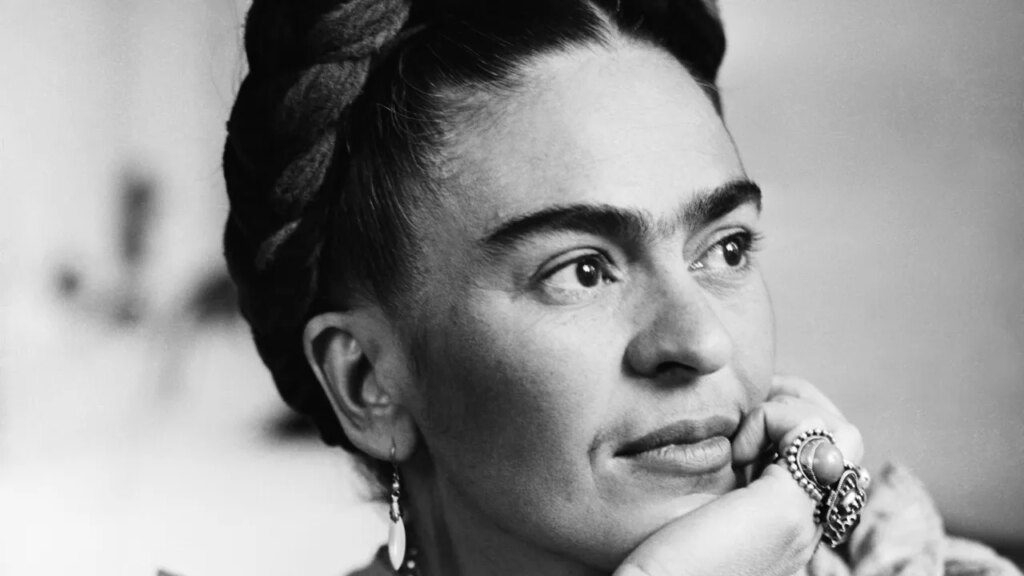
A new exhibition, Frida: The Making of an Icon, opening this month at London’s Tate Modern, examines just how this daring, unvarnished figure went from unknown and undervalued to global icon. It’s a life that clamoured for attention, her story reclaimed by successive generations. “Fridamania” became something of a pop-cultural phenomenon: Hayden Herrera’s 1983 biography, Frida, was a bestseller, a succession of museum exhibitions became landmarks, to say nothing of Salma Hayek’s portrayal of the artist in the 2002 film. “If somebody doesn’t like this painting, then I know they can’t be my friend,” Madonna once told Vanity Fair of My Birth (1932), one of several Kahlos she then owned.


Mexican painter Frida Kahlo, also known as Señora Diego Rivera, wife of the Mexican artist, holding a purple shawl and standing by tall plants outside. *** Local Caption *** Frida Kahlo;Toni Frissell, US Vogue, October 1937