
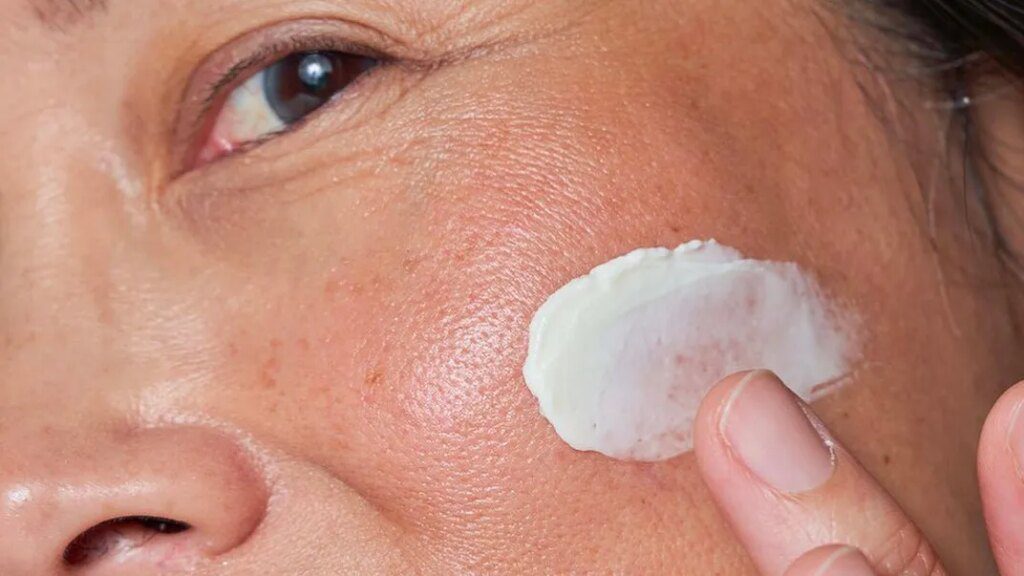
According to Magovern, a morning skin care regimen doesn’t have to start with face wash. “Don’t cleanse if skin feels dry or overprocessed, particularly if you did a good cleanse before bed,” she instructs. However, for mature skin that is “doing well and feeling strong,” she signs off on a gentle exfoliating cleanser that contains AHAs or PHAs.
Next up, a hydrating toner is “a great way to cleanse the skin without over-washing it,” she says, noting that “water can actually act as an irritant.” Follow the toning step with a serum that contains antioxidants, such as vitamin C, to protect and restore the skin. “You can also look for a serum with chemical exfoliators,” Magovern adds. “These can help remove some of those older surface skin cells and help the skin retain its ability to hold onto moisture and bring back the glow.” A rich moisturiser, followed by SPF, caps off the ideal morning regime.
In the evening, “gentle cleansers or oil cleansers are great choices for mature skin,” Magovern continues. “I prefer a gentle cleanser at night because subsequent steps tend to include more active products.” Exfoliation can also be part of a night-time regime, one to three times a week, but try not to do more than that as it could aggravate existing sensitivities. “It may not be intuitive, but exfoliating the skin can actually help moisturise it because it removes the surface dead cells, which make it harder for the moisturisers to penetrate and work effectively,” says Magovern. “Exfoliators also help stimulate collagen production.” For mature skin, she recommends a chemical exfoliator with gentle AHAs like glycolic and lactic acids, and PHAs, like gluconolactone, which have moisturising and antioxidant properties.
As a second-to-last step before bed, apply a treatment serum infused with active ingredients like retinol or peptides, which encourage cell turnover and cellular repair. “Sleep is the time when the cellular machinery is actively restoring and repairing, and it’s the perfect time to give the skin what it needs to help accomplish its night-time work,” Magovern notes.
Lastly, if you’re looking for the best night cream, apply a face moisturiser that helps the skin attract and retain moisture overnight. “Occluding the skin with a moisturiser also allows the active ingredients in the previous steps to penetrate deeper and perhaps work more effectively,” she says. “The moisturising step is important for nourishing and hydrating the skin while you sleep.”